
It is a Sunday afternoon and the house has gone quiet. A fifteen-year-old is sprawled across the sofa, phone face-down for once, staring at the ceiling. “I’m so bored,” comes the familiar groan. Half an hour later, that same teenager is halfway through building something odd out of cardboard, or sketching in the margins of an old notebook, or teaching themselves a bassline on a battered guitar. The boredom did not last. It turned into something.
Bored Teenagers
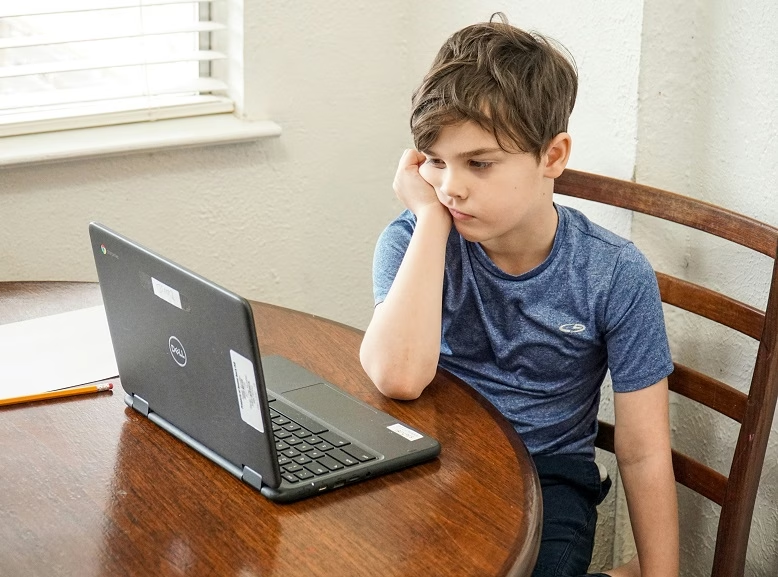
Most parents recognise this scene, and most of us instinctively want to fix it. We reach for a solution, a suggestion, a screen. Yet the moment of nothingness is often exactly where the good stuff begins.
The quiet space where ideas grow
Boredom gets a bad reputation, but psychologists have long argued that it plays a useful role. When there is nothing obvious to do, the mind starts to wander, and a wandering mind is a searching one. It looks for patterns, invents scenarios, and pieces together ideas that a busy brain would never have time to notice.
Teenagers feel this more sharply than most. Their inner world is expanding fast, and they need room to explore it. An afternoon with no fixed plan is not wasted time. It is the raw material of imagination. The trouble is that modern life leaves very little of it spare. Between school, activities, group chats and endless scrolling, few young people ever sit long enough to feel genuinely bored.
Why we should resist filling every gap
There is a strong urge among parents to keep teenagers occupied, as though empty time were a problem to be managed. Structure matters, of course, and so does encouragement. But a schedule packed to the edges can quietly crowd out the very thing creativity needs: unclaimed hours.
Think of the pursuits that tend to start in boredom. Writing stories, making music, coding a small game, redesigning a bedroom, taking apart an old radio to see how it works. None of these arrive on a timetable. They emerge sideways, in the gaps, when a young person is left to follow their own curiosity without being told what the outcome should be.
Good schools understand this balance. The best of them offer plenty to reach for while still leaving space to think, and schools that give young people room to develop their own interests often see that independence flow into stronger academic work too. Curiosity, once switched on, rarely stays in one place.
Turning restlessness into something real
So what can a parent do when the boredom sets in? Very little, and that is rather the point. The most helpful response is often the least active one.
A few gentle nudges can help without taking over:
– Keep interesting materials within reach, from sketchpads to instruments to secondhand books, and say nothing about them.
– Resist the reflex to hand over a screen the moment restlessness appears.
– Ask open questions rather than offering solutions. “What could you make with that?” travels further than “Why don’t you tidy your room?”
– Let a dull afternoon simply run its course. Boredom is uncomfortable, and that discomfort is what pushes a young mind to invent its own way out.
The aim is not to engineer creativity. It is to stop smothering it.
Bored today, inventive tomorrow
The teenagers who learn to sit with boredom often grow into adults who are comfortable with uncertainty and generating their own momentum. They have practised the quiet art of entertaining themselves, which turns out to be the same art as solving problems, starting projects and thinking for oneself.
Next time you hear that long, drawn-out complaint of “I’m bored”, it might be worth resisting the rescue. Somewhere behind the sighing, a mind is beginning to reach for something new. You can read more about how nurturing independent thinking shapes young people at https://blackrockcollege.com.
—
*This article was contributed by the team at Blackrock College, an independent school with a long tradition of encouraging curiosity, independence and well-rounded personal development in young people. Blackrock College supports students in building the confidence to explore their own interests and think for themselves, both inside and outside the classroom.*