
Ask most parents what they want from school and you’ll hear the obvious answers first: good results, a love of reading, confidence in maths. Then, almost as an afterthought, comes the thing that often matters most in daily life. They want their child to get along with other people.
It sounds simple. It isn’t. Learning to share, to disagree without falling out, to read the mood of a room and respond to it, these are some of the hardest skills a child will ever pick up. And unlike times tables, they can’t be memorised the night before a test.
Teaches Children About Getting Along
The problem with leaving it to chance
There’s a common assumption that social skills just happen. Put enough children in a room together and, given time, they’ll sort themselves out. Some do. But plenty don’t, and the ones who struggle often struggle quietly.
A child who hovers at the edge of a game, unsure how to join in, rarely announces it. A child who dominates every conversation may not realise why friendships keep drifting away. Left unaddressed, these patterns can harden. By the time they become obvious, they’re harder to shift.
The other issue is inconsistency. At home, children usually get plenty of one-to-one attention and few genuine rivals for it. School throws them into a far messier social world, full of competing needs and personalities. Without support, that gap can feel overwhelming.
What good schools do differently
The best schools treat getting along as something to be taught, not something to be hoped for. It shows up in small, deliberate ways rather than grand gestures.
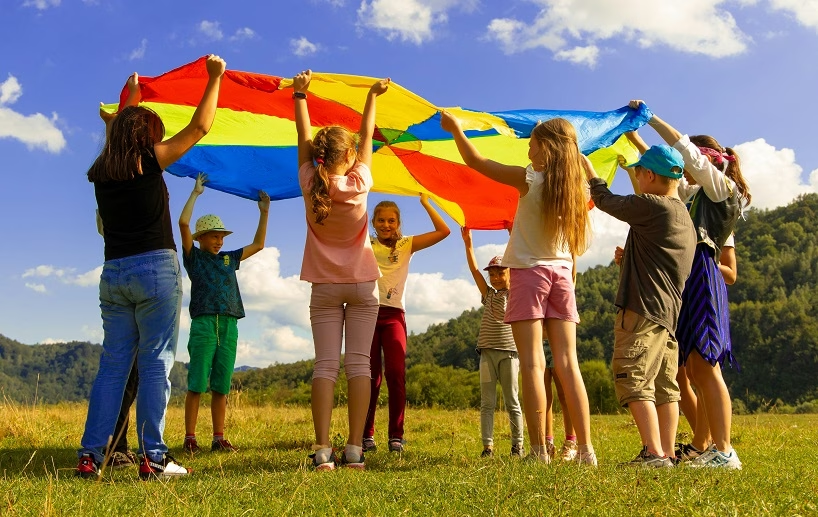
Group work is structured so that every child has a role, which means the quiet ones can’t fade into the background and the confident ones learn to make space. Playtimes are gently supervised, not to police fun, but to notice the child standing alone and quietly help them in. Disagreements are used as teaching moments rather than smoothed over. When two children fall out over a football game, a good teacher doesn’t just separate them. They help both sides say what they actually meant.
Sport, drama and music pull their weight here too. A child in a school play learns to wait for a cue, to support a nervous castmate, to accept that the show depends on everyone. A team sport teaches the sting of losing well and the grace of winning without gloating. These lessons stick precisely because they don’t feel like lessons.
Parents looking for a school where this happens by design rather than by accident often find it in [settings that treat character and community as seriously as academic results|https://holmewoodhouse.co.uk], where the social side of learning is planned for rather than assumed.
How progress actually looks
Here’s the reassuring part. Children are remarkably good at learning this stuff once they’re given the right conditions and a bit of patience.
Progress is rarely dramatic. It looks like a child who used to melt down over losing a game now shrugging and asking for a rematch. It looks like the shy one inviting a classmate round. It looks like an argument that ends in an apology rather than a sulk. These are ordinary moments, easy to miss, but they add up to a child who can navigate the world with other people in it.
The role of the adults, at home and at school, is to notice these moments and quietly celebrate them. Not with fanfare, but with the kind of steady encouragement that tells a child they’re getting it right.
Holmewood House School builds this thinking into everyday life, from the classroom to the playing field, because getting along with others is not a soft extra. It’s one of the foundations everything else rests on.
If your child leaves school able to read a room, resolve a squabble and make a friend, you’ve been given something that will outlast every exam grade. You can read more at https://holmewoodhouse.co.uk.
—
*This article was written by the team at Holmewood House School, an independent preparatory school in Langton Green, Kent, educating children aged 3–13. Holmewood House places equal value on academic achievement and personal development, helping every child grow into a confident, considerate member of their community.*